UI vs UX in 2026: What's the Difference, Why It Matters & How to Choose
By: Vimal Bhatt
Introduction
If you’re still unsure about the difference between UI and UX design in 2026, you’re not alone. With interfaces embedded in everything from smartphones to smartwatches and even self-driving cars, knowing the difference between UI vs UX is crucial for modern product designers.
Whether you’re designing for smart appliances, AI chatbots, or immersive AR interfaces, understanding these two design pillars is more important than ever.
This guide breaks down:
The core differences between UI and UX
How they work together in modern design workflows
Which one you should learn first, based on your strengths
What hiring managers are looking for in 2026
What is UI design?
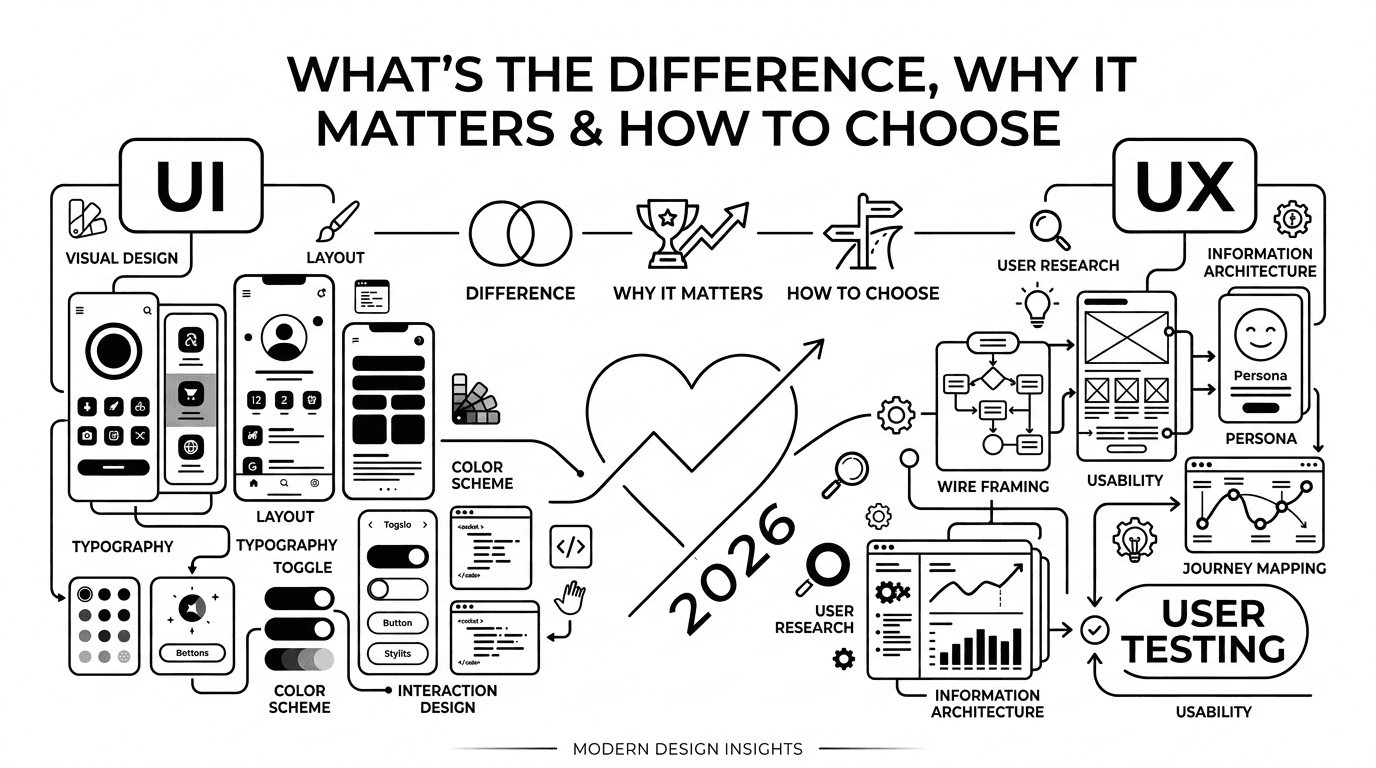
User Interface (UI) Design is all about how a product looks, responds and engages with the user. It’s the layout, colors, icons, typography, buttons, and micro-interactions that users directly engage with. Great UI design is visually appealing, easy to navigate, and consistent across devices.
At its core, great UI would include:
Intuitive visuals and interactive controls
Consistent layouts across all screen sizes
Simple, user-friendly navigation
Accessibility features that support all users.
When all these elements are in place, the result is a product that feels easy to use and looks great.
Today’s UI designers are working beyond screens. They’re also designing for foldable devices, smartwatches, in-car dashboards, and even VR/AR interfaces. Tools like Figma now use AI to generate layout suggestions, while design systems ensure brand consistency across multiple platforms.
What is UX design?
User Experience (UX) Design focuses on how a product feels to use, not just visually, but emotionally, functionally, and contextually.
In 2026, UX design is more than just usability. It’s about how users experience a product from their first click to their last action. A strong user experience design considers behavior, accessibility, inclusivity, and emotional feedback.
Some core aspects of UX Design would include
Gathering insights through surveys and interviews
Identifying problems through real-world testing
Including accessible and inclusive design
Structuring content for easy navigation
UX today goes beyond apps and websites. It includes voice interfaces (like Alexa), wearable tech, and even the experience of interacting with AI-driven chatbots. The role also increasingly blends with service design, customer journey mapping, and ethics, making sure products don’t just work, but also respect users’ data, time, and attention.
An analogy:
Think of UI as being the decor at a restaurant. It’s the colour on the walls, the lighting, the typography on the menu, and how nice the plates and utensils look. This creates the first impression, so everything is meant to feel inviting and visually appealing.
Just like in a great restaurant, when UX is done well, you barely notice it. Everything just works, the waiter appears at the right moment, your food is hot, and you never have to ask where the restroom is. That’s thoughtful UX.
What is the difference between UI and UX design
Now that we understand UI and UX individually, it’s easier to see how they compare, and why both matter in the design process. While they do often overlap, their goals and responsibilities are different.
Key differences:
Scope: UI is mostly digital,while UX covers digital and physical products as well
Focus: While UI emphasizes appearance and responsiveness, UX focuses on the feel, flow and user satisfaction.
Output: UI produces visual mockups; UX delivers wireframes, user flows and journey maps.
Goal: UI aims to delight the eye while UX aims to solve problems and streamline the user journey.
How UI and UX Design Work Together to Create Seamless Digital Products
Many people treat UI and UX as separate. But, in reality, they overlap constantly. In 2026, the best digital products result from both working together seamlessly. Here's how user interface and user experience design complement each other.
UX is the way the car drives, its responsiveness, comfort, and ease of use.
UI is the design of the interior, the layout of the dashboard, the feel of the steering wheel, the style of the controls.
Let’s take an app like Spotify:
UX ensures the flow from search → play → playlist is intuitive.
UI ensures that the play button is prominent, the controls feel responsive, and the dark theme is easy on the eyes.
If either one fails, the whole experience is affected.
Whether it’s an app, a website, or your favorite music player, the best digital products feel good and make sense. Achieving this balance requires thoughtful UI design and a well-planned user experience
Should You Learn UI or UX Design First?
By now, it’s clear that UI and UX are both crucial to creating good products.
UX follows a thoughtful process:
User Research, through interviews, analytics, surveys
Personas and journey mapping, which help in understanding pain points.
Information architectures organizing content logically
Wireframes and prototyping roughing out the experience,
Testing and Iteration where you learn what works and what doesn’t.
At its core, UX asks one thing: How does the user feel throughout the journey? Are they delighted, or did they bounce out of frustration? It’s empathy, built into design.
You might enjoy UX if you:
Like solving complex problems
Enjoy research, psychology, or behaviour design.
Care about accessibility and user testing.
UI (User Interface) design is focused on how things look and feel. UI designers choose colors, typography, spacing, animations, and layout. They create interfaces that are not only attractive but easy to interact with.
You might enjoy UI design if you:
Have a strong eye for visual design
Love working with typography, colour and animations.
Enjoy turning wireframes into beautiful, usable interfaces.
However,if you still can’t decide on just one, it helps to remember that in 2026, many roles blur, especially in startups or solo projects. Understanding both disciplines makes you versatile, even if you choose to specialize in one.
That being said, you don’t necessarily need both in order to succeed. It’s better to start with the one that fits your strengths and interests best. Over time, you’ll naturally pick up the other.
Frequently Asked Questions
Question: What’s the main difference between UI and UX design? Answer: UI (User Interface) focuses on the look and interaction design of a product, while UX (User Experience) focuses on the overall user journey, satisfaction, and usability.
Question: Which should I learn first: UI or UX? Answer: If you're more interested in research and strategy, start with UX. If you enjoy visual design and interactivity, begin with UI. Both overlap, and learning one will help you understand the other.
Question: Do UI and UX designers use the same tools? Answer: Often, yes. Tools like Figma are used for both UI mockups and UX prototypes, making cross-functional work easier.
Question: Is UI or UX design better for career growth in 2026? Answer: Both are in high demand. UX roles tend to be more strategic, while UI roles often require visual excellence. Hybrid roles are increasingly common.
Conclusion
Understanding the difference between UI and UX design is no longer optional. In a world where user experience drives product success, designers must learn to blend the functional with the visual.
Whether you're drawn to visual polish (UI) or strategic problem-solving (UX), both paths lead to creating better products. And in 2026, with tools like Figma making collaboration seamless, there’s never been a better time to explore both sides of design.
Start small, stay curious, and always design with real users in mind.
Let’s build something
Amazing together!
© 2025 Vimal Bhatt. All rights reserved